
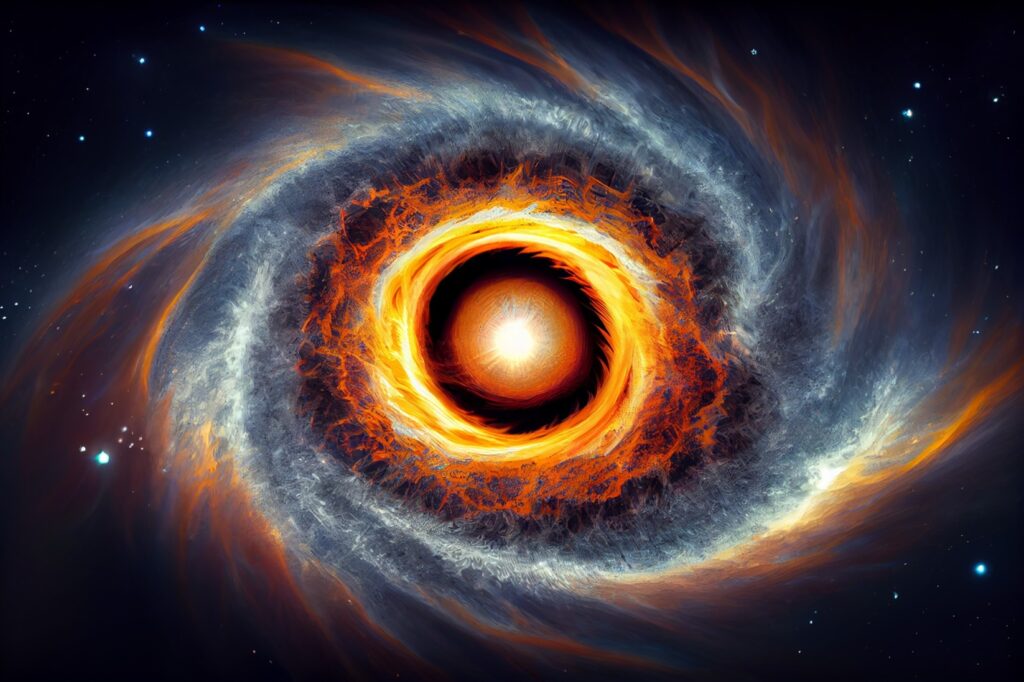

Time Travel Through Wormholes: The Science, the Paradox & The Possibility
Imagine finding a doorway hidden in the fabric of reality itself—a shortcut not just across space, but across the river of time. You step through and emerge into a world that hasn’t existed for a century, or perhaps one yet to be born. This is the ultimate fantasy, a concept that has fueled countless stories: time travel through a cosmic tunnel known as a wormhole.
Forget clunky machines with flashing lights. The most plausible blueprint for a time machine comes not from an inventor’s garage, but from the pages of Albert Einstein’s equations. The tantalizing idea that the universe might contain built-in tunnels, and that these tunnels could be manipulated for time travel, sits at the thrilling intersection of proven physics and boundless speculation.
But is it science, or just science fiction? Let’s journey together down the rabbit hole of general relativity, quantum foam, and temporal paradoxes to find out.
Time Travel Through Wormholes—Understanding the Concept
To understand the link to time travel, we first need to grasp what a wormhole is. In 1935, physicists Albert Einstein and Nathan Rosen explored solutions to the equations of general relativity. They found that the intense gravity of a black hole could, in theory, connect to another point in spacetime via a “bridge”—later dubbed an Einstein-Rosen bridge, or a wormhole.
Think of the universe as a vast sheet of paper. To get from point A to point B, you’d travel across the sheet. But if you fold the paper so the points touch, a wormhole is like a pencil punching through, creating an instant tunnel. It connects two distant regions, potentially billions of light-years apart, or maybe even two different times.
| Science Fiction Trope | Theoretical Reality |
|---|---|
| A stable, visible portal in space. | Microscopic, unstable, and likely invisible. |
| Easily traversable by humans and ships. | Would collapse instantly unless held open. |
| Used for space travel only. | Inherently connects both space and time. |
The Science Behind Time Travel and Wormholes
Here’s where it gets fascinating. According to Einstein’s theories, space and time are interwoven into a single continuum: “spacetime.” Gravity doesn’t just bend space; it bends time. A wormhole, by connecting two points in spacetime, inherently has one mouth existing in a different time than the other.
But for it to become a functional time travel machine, you need to create a time difference between the two months. Renowned physicist Kip Thorne and his colleagues explored this in the 1980s. The method is mind-bending:
- Create a Wormhole (Somehow): We assume an advanced civilization could stabilize a microscopic, primordial wormhole predicted to exist in the quantum foam.
- Move One Mouth: Take one mouth of the wormhole and embark on a journey at near-light speed, or place it near an intense gravitational field like a neutron star. According to Einstein’s theory of Special Relativity (time dilation), time passes slower for the moving mouth.
- Establish a Time Difference: After a year for the traveling mouth, ten years might pass for the stationary mouth. The wormhole now connects the present to the past (of the stationary mouth) or the future (of the moving mouth), depending on the direction you travel.
You now have a two-way tunnel through time. Step in mouth A in the year 2040, and you exit mouth B in the year 2031. The time travel is achieved.
![Infographic Description: A simple graphic showing two funnel-shaped wormhole mouths (A & B) connected by a throat. Mouth A is labeled “Stationary – Year 2040.” Mouth B is shown next to a spaceship and is labeled “Traveled Near Light Speed—Year 2031.” An arrow indicates that entering A in 2040 leads to exiting B in 2031, and vice-versa.]
The Cosmic “No”: The Challenges That Shut the Door
The math might check out, but the universe seems to have installed formidable safety locks against time travel. Here are the monumental hurdles:
- Exotic Matter with Negative Energy: To keep a wormhole from pinching shut the moment anything enters, you need a substance that generates negative pressure or repulsive gravity. This “exotic matter” is not antimatter; it’s a hypothetical substance that violates the classical energy conditions of physics. While tiny amounts of negative energy density might exist due to quantum effects like the Casimir Force, the quantities needed to hold open a human-traversable wormhole are astronomically beyond our reach.
- Instability & Feedback: Even if stabilized, the moment you try to use a wormhole for time travel, most models suggest quantum fluctuations would amplify catastrophically, creating a feedback loop of infinite energy that destroys the tunnel. This is related to the “chronology protection conjecture” proposed by Stephen Hawking, which suggests the laws of physics conspire to prevent time machines.
- The “You Can’t Get There From Here” Problem: We have zero evidence that macroscopic, traversable wormholes exist naturally. Creating one would require manipulating spacetime at a fundamental level, a technology so far beyond our understanding it’s essentially magic with an equation.
Wrestling with Paradoxes: What Time Travel Would Truly Mean
Beyond the engineering nightmares lie the philosophical bombshells. If time travel to the past were possible, it invites paradoxes that challenge the logical consistency of the universe.
- The Grandfather Paradox: The classic. If you go back in time and prevent your grandfather from meeting your grandmother, do you cease to exist? If you cease to exist, you couldn’t have gone back in time to do the deed.
- The Bootstrap Paradox: An object or piece of information is sent back in time and becomes its own origin. Who wrote Beethoven’s Fifth? A time traveler could give young Beethoven the sheet music, which he then publishes. The symphony has no true origin.
Physicists have proposed potential “solutions” to preserve logic:
- The Novikov Self-Consistency Principle: This asserts that any actions taken by a time traveler were always part of history. You cannot change the past because you already did what you will do. Your attempt to kill your grandfather would inevitably fail.
- The Many-Worlds Interpretation: Here, traveling to the past doesn’t change your own timeline. Instead, you branch off into a new, parallel universe. You could alter that new timeline without erasing yourself, but you could never return to your original future.
These aren’t just plot devices for movies; they are serious considerations that show how time travel forces us to confront the very nature of causality and reality.
A Personal Reflection: Why the Dream Endures
I’ll admit, as a child devouring H.G. Wells and watching Back to the Future, the mechanics didn’t matter. The appeal was the ultimate human desire: for a second chance, for the ability to witness history firsthand, for the power to correct a mistake. The wormhole time machine, rooted in real science, feels like a promise—a whisper that the universe might be more strange and wonderful than we dare to hope.
Yet, as an adult studying the physics, I find a different beauty. The fact that our best understanding of reality allows for the concept, even if it likely forbids the practice, is astonishing. It means our universe is a dynamic, flexible fabric, not a rigid stage. The quest to understand time travel through wormholes has led to profound insights into quantum gravity, black hole thermodynamics, and the origin of the cosmos. The destination may be unreachable, but the journey has revolutionized physics.
Conclusion: A Beautiful, Closed Loop
So, can we ever build a wormhole time machine? Based on our current knowledge, the answer is almost certainly no. The barriers of exotic matter, instability, and cosmic censorship are staggeringly high.
But the idea remains one of the most powerful thought experiments in science. It teaches us that time travel isn’t just fantasy; it’s a rigorous extension of general relativity. It forces us to ask deeper questions about the universe’s structure and the flow of cause and effect.
For now, the only time travel we possess is the kind we’re all doing—moving inexorably into the future at a rate of one second per second. And perhaps, in using our minds to voyage to the edges of theoretical physics and back, that’s enough of a miracle.
What’s your take? Does the potential for paradox mean time travel is forever forbidden, or do you think a future civilization might crack the code? Share your thoughts in the comments below—and if you’re fascinated by the edges of reality, subscribe to our newsletter for more deep dives into spacetime, quantum weirdness, and the future of physics. Let’s keep exploring together



Pingback: Biocentrism: Does Consciousness Create Reality? - wordtopdf.click
Pingback: If No One Observes It, Does It Exist? The Biocentrism Controversy - wordtopdf.click